Philadelphia Artists' Collective
 
Picture
Tonight is Industry Night for TIMON OF ATHENS. And I’m inherently nervous. It’s my first big Industry Night in Philly, and I’m worried about… well, everything. So let’s try and put an end to this, shall we?

A funny thing has happened to me over the past few weeks. I think I may have started to... relax. A little bit. If you know me at all, this may be somewhat alarming for you to hear. Let me explain. I came into rehearsals for this production extremely nervous. My thoughts would fluctuate every single second of rehearsals, sounding something like, “Holy crap, look at the cast! Holy crap, look at that production team! Oh crap, look at me… No, don’t look at me! I’m not ready, I’m not prepared!” I’ve been that way for a while - always worrying I’m not working hard enough, or maybe I’m working too hard and I’m forcing something. These thoughts are, to say the least, annoying. It wasn’t until runs of the show started that I was finally able to get my thoughts together and come to a somewhat relieving realization.

Being in a Shakespeare piece, something that happens to be around four hundred years old... It starts to put things into perspective. After weeks of worrying, I’ve come to learn something: This is all so much bigger than me. This production is so much bigger; this play is so much bigger. And I have two choices: (1) I can worry about how unprepared I feel, and pace and fret backstage before every single scene, because of who might be watching tonight and what they might think of me. Or (2) at some point I can accept my place in this world and give it all up to something bigger. And I do mean the world of the play… mostly.

In the world of this play, I’m a servant to Timon. In “real life,” I work in a restaurant, refilling water glasses and polishing utensils and glassware for people who have a lot more money than I do… Not so different from what I’m doing in the play, I suppose. So it really shouldn’t be that hard to relate. Of course, the stakes are a little higher. Okay, a lot higher. But it’s not my job to force those stakes on the audience. My role in relation to this production and this play is also somewhat the servant. It is my job to hold the door and hopefully not get in the way.

This play is much older than any of us, and its message much stronger than anything I could try and play at on the stage, or type here for you now. It’s already profound enough, without my trying to ad to it. So instead, why not give it to you simply? Why not just hold the door open, and let you walk in yourself? There are very few points in the show when the focus is actually on me. And that is a HUGE relief. Seriously. At this moment in my life, it is completely relieving and enjoyable to offer the heavy lifting to other people, and just be there to fill the wine, so to speak.

Please don’t misunderstand me. I am in no way saying my role is insignificant. In fact, I mean just the opposite. If there’s anything I’ve learned throughout this process, it is that everyone is essential. And I mean everyone. It is a truly wonderful thing to be a tiny cog in a big, beautiful machine. Working as part of the apprentice company has been incredibly eye opening, and it has taught me that every little bit helps. The people at the PAC are not afraid to ask. And that’s a comforting thing. It’s kind of nice to be asked, isn’t it? It is. Honestly, it is nice to feel needed. It is a very good feeling to know you’re helping a company of people you believe in, and know you wouldn’t rather be anywhere else.

So, that brings us back to the play. Someone’s got to say these lines and fill these wine glasses. And if that means getting to be a part of the telling of this great story, lifting up this text to a new audience every single night… then Sign. Me. Up. I will hold all the doors and fill all the glasses in the world to just be in the room every night and be a small part of that experience.

But really, no matter the size of the role, I think that will always remain true. With what we do, there comes a certain responsibility. And that responsibility can be frightening at times. But I think it’s helpful to remember that it’s not just my responsibility. I am one of many people united in telling this story. At some point, all of us must admit to ourselves and accept that we are simply serving a greater message, a greater purpose. And we can find true comfort in that. So with that, I walk into the theater tonight and hold the door open for you. Come and listen to this story. And hopefully I won’t spill wine on you.  


Brendan Dalton
PAC Acting Apprentice


Picture
You have just a few more days to catch Brendan in TIMON OF ATHENS, onstage now through April 20th.
 
 
Picture
To be an artist in the theatre is something special.  Theatre is similar to film in that it has writers, directors, technicians and so forth, but theatre lacks a permanence that film possesses.  Your favorite film remains the same every single time you watch it (which is lovely), but theatre is necessarily temporary.  You can never quite pin it down. Admittedly, a single theatrical production will likely have the same director, actors, designers, crew, script, etc. from night to night, yet there is something fundamentally different from one performance to the next.  Just as a moment is captured, it disappears.  It exists only in the space and time that living people are in a room together.  It exists between the actors, yes, but more importantly it thrives in that fraught space between the actors and the audience. Sometimes, it only lasts the length of a breath.

By nature, a theatrical production lives, changes and - perhaps most importantly – it dies.  Ultimately a play lives only in the minds of the people who were in that room.  And if you weren’t there, then no number of photos or reviews or stories at the bar can recreate it.  Now, this is all very well and good, and it’s part of the magic that we all love so much.  But if those of us in the theatre are ultimately sculpting in butter, then the great question “Why?” can rear its ugly head a lot.  And the “Why?” is what keeps me honest. And keeps me up at night, as my wife can attest.

If everything we are doing ultimately disintegrates, then I feel a great need to be a part of something larger. This is where the classics come in.  They are a direct link not only to the musty-dusty “past,” but to our very history.  By working in classical theatre, one becomes a part of the larger theatrical narrative.

Shakespeare’s plays (for example) were here for centuries before I was even a notion. Centuries before my great-grandfather sailed for America from England. And they will be here long after I am dead.  These plays, and their relationship to our very culture, are larger than any one person, or even one group of people. They have been translated into countless languages. They have been taught, in some form or another, in nearly every corner of the English-speaking world (much to the chagrin of many high schoolers everywhere). They have crossed borders of countries in times of extremity and war. They are quoted, intentionally or unintentionally, by most folks in their daily lives.

By working with these texts, one gets the chance to become part of the history.  In a business devoid of permanence, an artist can claim a foothold.  Now that is something.

Now, this is not to say that every production of The Tempest or Macbeth is immediately ennobled. But anybody who’s played Lady Macbeth in their church basement as part of their community theater’s spring show is now part of the story. And the story just keeps unfolding.  It’s a bit like the “begat” section in the Bible – you can trace the lineage all the way back.  I saw Vanessa Redgrave as Prospero, who saw her father Michael Redgrave give his Prospero, who saw Robert Atkins’, who saw Benson’s, and so on back to the first. Back to the first.  

It’s one of the reasons I love the classics as much as I do.  It’s one more way I remind myself that the work ultimately isn’t about me. It’s about something larger.  A direct connection with our history as artists, storytellers, people.  And there’s a responsibility that comes with it.  One isn’t simply creating an ‘evening out’ that can be forgotten within a few days but, rather, doing everything possible to do right by all those who came before. 

Classical plays can feel like medicine.  There is something sickly familiar, vaguely sweet yet ultimately distasteful as we swallow them down and mutter to ourselves how it is for our betterment that we take in these necessaries.  But my hope, my goal is something very different.  These secondary classics have the opportunity to thrill and challenge us in unexpected ways.  It is far less likely that we can quote passages of Timon from the dark of our seats.


Timon of Athens is a particularly curious case.  There is no record of its ever being performed during Shakespeare’s lifetime – it exists within a fractured history.  Never popular, and often regarded as a co-authored piece or an unfinished manuscript, the responsibility to its history becomes very large.  We can only trace it back so far before it disappears into a cloud.  In this case, the story of this play is a mystery.  And our job as artists is not necessarily to try to solve it, but to give you the pieces of the puzzle and let you try to figure it out on the car ride home.  In that way, you are part of the history as well.

Dan Hodge
Co-Founding Artistic Director
Philadelphia Artists' Collective


Picture
Lend to each man enough/that one neede not lend to another.

I recently had the experience of turning down a job I had agreed to do because another opportunity presented itself. The first job, an opera, would have paid me $1800 for six weeks of my time, plus my travel and onsite housing expenses. They could provide a sewing machine and basic supplies, but they were currently in discussions as to which part of the lobby or rehearsal hall they could find space for an ironing board and a sewing machine. The job description included the design, alterations, maintenance, and then wardrobe run crew for a large opera, in addition to the oversight of the apprentice company production’s costume needs.  

The second job offer, a teaching job, will pay me $5400 for nine weeks of my time, allows me to have my nights and weekends free, and lets me design my own curriculum for a roster of eager kids who want to learn how to make puppets and masks and props and costumes.  It also allows me to take a smaller design job on the side, and gives me the chance to work with a friend whom I’ve been dying for an opportunity to collaborate with.

It was a no-brainer. I would have loved to go to an unfamiliar part of the country, work with some amazing new people, swim in the river, design my first opera. I would also like to eat more than just canned tuna every meal, and stop dodging collection calls from my student loan agency.

When I phoned the director, she understood completely, and urged me to contact the producer, who now has four months to find a replacement. When I contacted the producer, she questioned my “loyalty and integrity,” and asked the question “If everyone jumps ship for the next job, whether it be higher-paying or more prestigious, then how do you define ‘trust’?”

*

I’ve been swirling around Timon of Athens in my brain for months now. Sitting in a room listening to the actors try to unpack it, I can’t help but feel uncomfortable with the parallels to my own life, of the lives of the people in the room, of the lives of countless other people who have been impacted by the economic downturn.

In case you’re unfamiliar with the play: Timon of Athens is the nicest, richest dude in the city, surrounded by friends, giving lavish dinners and tossing off gifts and jewels to everyone he meets. In the very first scene, Timon meets a Poet and a Painter, two characters who are acutely aware that if the richest guy in town sees and likes their work, their own fortunes could take a drastic turn for the better.  

At a wedding I attended recently, populated by many former theatre majors, I was struck by the number of times I had variants of the same conversation:

“So… remind me, what do you do again?”
“I’m a costume designer.”
“… No, but…. for money?”

I’m one of the lucky ones. I haven’t had a day job in years. I piece it together: Design jobs. Teaching jobs. Running-around-backstage jobs.

I have flexibility and options. I choose my own work hours.  I accept or decline jobs as I see fit. I’m incredibly fortunate that my name and my work have permeated this community; I haven’t actively sought out design work in two years and offers still come my way. I work in my pajamas a lot. It’s glorious. 

I am also, quite frankly, exhausted. Choosing my own hours is a synonym for choosing to work as many of them as my body and physics will allow. I accept as many jobs as I can, because I am terrified that there will not be another. I eat in my car more than I care to admit. At the end of this season, I will have designed 14 plays, two dance concerts, and one large-scale costumed gala, on top of marketing/web duties for the PAC, oddball stitching jobs, the occasional box office or wardrobe gig. I routinely work 70+ hour weeks. This year, I’ll make less money than I did as an apprentice.

*

You shall perceive/How you mistake my Fortunes: I am wealthie in my Friends.

In the second act, Timon’s lost everything. His personality shifts; he becomes an angry misanthrope, disavowing money entirely, railing against his former friends who would not bail him out when he needed it.

I was having coffee recently with an acquaintance, someone about my own age, another artist friend. I expressed that I had been feeling a little down about myself and my career lately. She looked shocked. “But… but you’re so successful. I mean, you work all the time. You’re booked so far in advance. That must be amazing.

I was stunned. I feel like I’m constantly teetering on the brink of disaster, that all it will take is one more car repair or one more bounced check to put me into a tailspin. I’ve joked with friends in similar predicaments that we all have canned goods stocked up for just such times; the next time we all realize we have 87 cents to our name, at least we can pool our resources and cobble a stew together. I’ve been feeling nothing like a success. Yet in that moment, I saw myself the way that others might – young, constantly surrounded by art, challenged by my work, doing the exact thing that I had set out to achieve when I moved here nearly five years ago. That reality is wonderful. I’d like to exist there more often.

*

I must not break my back/to heale his finger.

The synopsis of Timon is pretty … well, basic, right? Guy gives his friends a bunch of money. He runs out of money and asks them to bail him out. They don’t. He loses his mind and runs off to the woods to curse the names of his false, flattering friends forever.

It doesn’t make the friends look so great.

At least, that’s what I thought until I sat in rehearsal, the harsh words from the opera producer still storming around my brain. I suddenly found myself sympathizing with the villains. The poet and the painter in this play can come across as kind of douchey. And yet I found myself understanding where they come from. Of course they’re hanging out near the rich folks, hoping they’ll see their work validated, hoping they’ll gain a scrap of recognition, a sale to a wealthy patron. It’s what artists have essentially done throughout history. It’s rooted in this gnarly power dynamic – the person who needs money is constantly and acutely aware of the person who can provide it.  Art as a commodity. The artist as a product. It’s the perfect storm that leads to the kind of situation I described earlier – I jumped ship for a better opportunity, without thinking twice. I felt shitty about it. But I wanted to eat.

I’m no better than those fictional characters at all, actually.

There’s a nuance to this part of the process, and I have so much to learn. Everyone in this business has all kinds of advice, some useful, some confounding – Negotiate up for more money. Accept only jobs worth your time. You’re building a career, you have to say yes to every opportunity. Take fewer jobs and get something part-time and steady! Maybe you should just go back to school for awhile. 

I don’t have the answers. But it’s reassuring to know that these aren’t new problems. If Shakespeare was writing about this 400 years ago – it means that artists have been asking these questions for literally hundreds of years. It means that there is a relevancy to producing this play, here and now. The language is different, but people have stayed pretty much the same. I don’t know if Shakespeare has the answers either, but if nothing else, it really helps to be in a room with other people focused on asking the same questions, muddling through it together, both onstage and off.

And hey, if anyone reading this has the answers to all these questions, give me a call sometime. I really would like to know if anyone else has figured this out. (Although … I can’t pay you for it right now. Will you take a check?)

Katherine Fritz
Artistic Associate
Philadelphia Artists’ Collective


Picture
I wear a lot of hats at the PAC. In addition to serving as the resident costume (and sometimes set and props) designer, I'm the web guru, postcard and graphic designer, co-marketing director, and apprentice coordinator. I haul platforms around, once drove a truck filled with lumber through rush-hour city traffic, and give curtain speeches at opening night, even though that part makes me incredibly anxious. I'm the one who keeps an eye on the blog, who assigns writers and makes sure that we have new content coming at regular intervals. 

So the marketing director side of me is really about to kill the designer side of me. I had every intention of writing a blog about the design process for Timon of Athens, how I was inspired by the stark black and white photography of David Comdico, how the stunning architecture of Broad Street Ministry needs such little embellishment, how I looked for weeks at high fashion runways and greek peasants and avant-garde art films and jewelry designers, pouring all of those things into my brain and waiting for the design to emerge. The marketing director side of me likes to post things about how everything is great, how we're making art that we think is important, how joyful we all are to be in a room filled with like-minded people who just want to create and explore together.

And, okay, all of that is true. There's just more to the story than that.

A lot of people are familiar with the phrase "writer's block." It's true for designers, too. I did spend weeks looking at fashion spreads and at hammered gold bowls, drapey Moroccan curtains, gold headdresses, braided updos, guyliner. I read the play. I read the play again. I looked at pictures of the production I saw of Timon while I was in London this fall, trying to capture the essence of what I liked and disliked about their concept and version. I read the play again. More research. More research. More research. 

And then I stared at a blank page on a blank desk. And stared at a blank wall. And drew things I hated, and erased until there were holes in the paper and eraser dust in my lungs.

Sometimes it's just not there. Sometimes when you stare at a blank page, you see endless possibility. Sometimes, you just see your own shortcomings and failure. 

The best part about working with the PAC is that I'm in the company of some of the smartest, funniest, most thoughtful and insightful people I know. The worst part is that when I feel as if I can't keep up, I'm disappointing the smartest, funniest, most thoughtful and insightful people I know. 

Read the play. Stare at the wall. Take a nap. Take a walk. Look at fabrics, rows and rows of fabrics, rolled on cardboard tubes and stacked on industrial shelves in fluorescent-lit warehouses, trying to imagine them cut and draped and shaped onto human forms, seeing only stubborn rectangles instead. I started giving myself ultimatums. Before I would go to sleep, I would think, "tomorrow you will wake up and you will be brilliant. Tomorrow you will wake up and this will all come together." I would wake up and think, "maybe I just need some coffee before I can be brilliant. Maybe I just need to eat a sandwich and check my email and then -- THEN! - this will make sense."  And then I would fall asleep and think, "okay, so today it didn't happen. Tomorrow, though. Tomorrow, for certain. It's just that this is a new type of project for you. It's just new, that's all." And immediately before falling asleep, these swarming, nagging thoughts would whisper in my ear, Since when have you been afraid of trying something new?  They gave way to something more insidious. Maybe, I would think, maybe it's just that you're no good at this. You're a hack, not an artist. Maybe you're failing simply because you are, in fact, a failure.

The day it turned around for me wasn't much different in many ways except - that day, a few weeks ago, I woke up, and sat down, and drew, and I didn't hate it, and I kept drawing, and I kept drawing, and I kept listening to music and pulled out my watercolors and oh, thank god, here we go,  thank you. I kept drawing, I kept painting, three cups of coffee, four, let's just drink coffee all day.  Finished those sketches in the Apple-Hodge guest room, locked myself in with some watercolors as the cast of Timon drank tea and laughed in the kitchen downstairs during an early pre-rehearsal workshop, hiding my sketchpad from Dan, still not ready to show him, just in case I woke up in the morning and hated it all still.

When I was younger, I had somehow imagined that when I worked, I would work in an airy, spacious office - the kind with tall ceilings and exposed brick and vintage dressmakers' dummies and fancy paper and watercolors at a moment's notice. I'd be the kind of designer who wore scarves and whose earrings jangled in the breeze that would seep through the fifth-floor sunny windows. The reality is that I work in a pair of men's paint-splattered sweatpants I stole from costume storage of a play I designed years ago, in a small room in my South Philly rowhome; I haven't plucked my eyebrows in a week and I didn't shower this morning and my hand is smudged with graphite and I must have scratched an itch because there's a smudge of violent violet pigment just under my right earlobe.  Here's the thing:  the reality of what I do is probably vastly more productive, dare I say more interesting, than the fantasy. While we all want to create our work in a cabin overlooking a waterfall atop a beautiful mountain, the reality is that the work has to get done, be it from a coffee shop or from our basement or from a corner of a good friend's spare room. And - dare I say? - maybe that's because I work better like this. Maybe I need to see the good side of not having that cabin in the mountains or the spacious office. I'd be willing to bet even the people with those things have weeks like this too, where even the nicest environments and the best tools don't spare them from similarly frustrating experiences.

Because here's the craziest part of all - I finished the drawings, and I presented them to the cast, and I could feel my own excitement bubbling up as I narrated. All the stuff that had seemed really cool to me in the beginning that then I couldn't get inspired by? It now seems really, really cool again. My basement is filled with thrift-store sandals and drapey Greek tunics and bolts of muslin. I have all the ingredients assembled in front of me, in my cramped and decidedly unglamorous basement workspace.

And now? Now the real work begins. Time to actually turn into reality what I struggled to put on paper. It's possible I'll still fail, that I'll get to tech, see the clothes on real bodies in real space, put my head in my hands, let those voices creep back in, you failure, you hack. Or maybe - just maybe this time - I'll have one of those shows where I see my work and it honestly fills me with delight, that I created a world from nothing and put it in a room for people to see.  I hope it's the latter. And I hope you come talk to me about it. I'd love to talk to you.

Katherine Fritz
Artistic Associate, Philadelphia Artists' Collective


David Comdico is a Philadelphia-area web developer and photographer.
 
 
Picture
From time to time at the PAC, we'll hand the blog over to guest artists who are working with us. We can't wait for you to meet our inaugural class of apprentices, who will be sharing their experiences here on the blog.

A few weeks ago, I attended a rousing reading of The Country Wife at Broad Street Ministries. As I traveled coffee in hand (I was told to count on a late night) toward BSM, I had no idea what to expect. I arrived to friendly PAC faces, who had clearly been running around all day for the upcoming staged reading. Although it was clear lots of effort went into creating the event, I sensed no stress, panic, or overwhelm in the PAC team. Everything was in control, which calmed me down. 

In fact, the more I helped out moving tables and making the cookie and tea table look fit for even Dionysus, I became excited. Everything was falling into place. The actors had just finished blocking each entrance and exit for the reading. Because they would be performing script in hand, not much stage action would be possible. By the snippets of dialogue I caught while Krista put the finishing touches on the reading, not much stage action would be needed. I had a feeling this would be one of the plays where the language and the writing would have most of the action.  Around 45 minutes to "curtain," Krista and Fritzy began briefing me on what to expect as the box office staff. I was handed a list of names-clearly very dear to PAC. This was a free event - the PAC thinks it's really important to make art that everyone can afford - and were expecting familiar theater family and fans to come and enjoy the night with them. As I flipped through the names, I became excited again- I KNEW some of these people! A lot of them were affiliated with Temple (I'm an undergrad) and I recognized a lot of them from shows I've seen around town. 

When the doors opened to arriving guests, something unexpected happened. Many people showed up without pre-ordered tickets. I was told to put these guests on a waiting list and to let them into the theater after the audience members with ordered tickets had been seated. The list grew longer and longer, and eventually the masses were let in. I was relieved when Fritzy came out to help me with the crowd. I was even more relieved when we were able to let EVERYONE in. Fritzy held her head in disbelief as she muttered to me "this is BY FAR the biggest crowd we've ever had at one of these!" GO PAC!

 The reading itself was such a success. From Dan's pre-show speech onward I could tell the crowd expected an entertaining evening and was happily contented with the performance. Krista cast a beautiful set of actors and each used the language of The Country Wife with skill. The plot was complicated, but not difficult to follow. The silly farce-like quality of the play was not lost in the static form of the reading. The playful language helped create the world of the play, and I had no trouble suspending my belief of the story.  When the show ended, the audience happily talked to each other while politely heading out home. This was nice- it left us apprentices and PAC crew to do the dirty work of clean up as quickly as possible. After stacking chairs, taking down lights, and moving a stubbornly heavy piano, we were ready to head out. The night was a great success! This was my first sample of a staged work done by PAC. I think it was a nice preview of what's to come from Timon! SUPER EXCITED!

Angie Fennell
PAC Acting Apprentice


Picture
Acting Apprentices Angie and Merci are ready to go, coffee in hand, before the reading. The apprentices helped with every aspect of the evening, from hauling platforms, installing lighting, reading stage directions, and even taking pictures - apprentice Ashley Thornton snapped this shot as well as documenting the reading for our archives. Check back with the blog soon, as we'll be detailing all the behind-the-scenes info when we launch into TIMON OF ATHENS rehearsals in the upcoming weeks!


Picture
From time to time at the PAC, we'll hand the blog over to guest artists who are working with us. We can't wait for you to meet our inaugural class of apprentices, who will be sharing their experiences here on the blog.

Happy (almost) February, folks! These past few months, my fellow PAC Acting Apprentices – Merci, Ashley, Angie, Brendan, Adam, and I – have had the great pleasure of workshopping a bit of Shakespeare under the instruction of the mighty-talented Dan Hodge and Krista Apple. And while it has been an amazingly enriching experience, performing Shakespeare can also feel impossible at times. Let’s face it. Shakespeare at times can be completely dense and elusive. Sometimes at the end of the day you feel like a lonely actor in a stale room rambling on and on, wondering if anybody’s listening to you speak! I find myself asking … is this what a Shakespeare monologue is supposed to feel like?! And, perhaps more importantly, why does dealing with Shakespeare oddly remind me of my relationships with men?! And, no, I’m not just talking about the romantic plotlines. Maybe it’s because Valentine’s Day is just around the corner or maybe I’m just plain crazy, but … in my own life I sometimes also feel like I’m talking to a wall. But at the risk of sounding like a complete Negative Nancy, I’ve made enough progress to know that Shakespeare, just like relationships, requires hard work. And though daunting at first, if you play your cards right it is very possible to breathe passion, sincerity, and life into your relationships . . . and those monologues too, of course!

And in case you are wondering, I do not dispute that I may in fact be as over-the-top and hysterical as some of these Shakespearean ladies I have been somewhat living vicariously through all my life. I’ve been assigned Helena’s monologue in ALL’S WELL THAT ENDS WELL, Act I Scene III. (Thanks Krista!) Much like some of these fierce female characters, I would like to think that I have lived, loved, and learned like they have. These are just a few PAC workshop teachings that I hope will be as helpful to you as they have been to me in approaching and understanding Shakespeare as well as my own love life to boot!

Opt for Optimism

Just because a character seems to be in a ridiculously hopeless situation does not mean that you have to play that character with hopelessness in your tone! Perhaps you, the actor, might think they are hopeless – but the character might not think so. I initially had the natural impulse to want to play Helena as self-deprecating and simply pathetic, but Dan suggested that I try to approach the piece with more bright-eyed optimism. And though at first I was skeptical I quickly realized that it not only made Helena’s speech more interesting, it added another dimension to the character that I felt was satisfyingly honest and empowering. This kind of approach to Helena actually made me think quite a bit about my own relationships. Even when all seems hopeless (it’s been six weeks, why hasn’t he called?!) it’s important to maintain a sense of good humor and optimism. At the end of the day, even if love isn’t reciprocated it’s still what you feel and you are allowed to own it, relish in it, and believe it… at least until it drives you completely insane. Then maybe it’s time to stop living in fairyland!


What are you talking about Vs. Who are you talking to?

I got caught up in what I believed to be the only important point in the monologue, Helena’s overwhelming love of Bertram, that I forgot that there is someone else in the room I’m supposed to be talking to! Have you ever found yourself spilling all the beans to your best friend? I know I’ve been there and I’m just as invested in my relationship to the person I’m speaking with as I am with the person I am talking about. But I am certainly not talking to a wall. Dan detected that I was hitting this “wall,” so to speak, and urged me to not neglect the love and respect Helena also has for the person she is speaking with. In the end, balancing what I was talking about and whom I was talking to surprisingly made my speech more fluid, sincere, and connected to the other actor/audience in the room.

Sometimes Less is More

With Shakespeare many have the tendency to jump to the conclusion that things have to be performed in a big and grandiose way. And while it is important to “give yourself permission to go over the top,” Dan personally challenged me to maintain simplicity in Helena’s monologue. For me, this is a challenge. People often think that I am dramatic in everyday life, as if it’s a result of simply being an actor. In fact, I am realizing more and more that I have a tendency to be overly dramatic as an actor as a result of the insanities of everyday life! But I’m beginning to understand that sometimes all a relationship needs to find its harmony is less emotional-overload and more soundness of mind. So while Helena is clearly head-over-heels in love with Bertram, Dan reminded me that Helena hasn’t completely lost it. Focusing on a path of reason helped me to keep my speech focused, clear, and simple in a way that I felt it was easier for the audience to follow, and easier for me as an actor to believe more in the words I was saying.

I think the most important thing I am learning these days is that every monologue, just like every relationship, has its own unique needs and it’s ultimately up to you to figure out exactly what those are and to find the approach that works best for you. So what do you need to work on this year? More optimism? Or more realism? Having a louder, bigger, and better presentation than the next guy, or is subtlety your new best friend? Should you do grand gestures like flowers, chocolate, and then recite a sonnet on top of a mountain as the sun is setting to show just how much you love that special someone? Or maybe what you really need to focus on is as simple as mastering the art of articulating how you feel about that special someone without sounding like a complete blabbering buffoon (hint: I _____ you? You can fill in the rest!)

Till next time! Best wishes to all the Valentine’s love-birds and Shakespearean-hopefuls!

Victoria Chau
PAC Acting Apprentice


Picture
I love the Restoration for many, many reasons. We can thank this short, vivacious period of history for Wycherley’s brilliant satire The Country Wife. We can also thank the Restoration for… wait for it… the Commemorative Coffee Mug.

Here’s the story, or so it goes: when Charles II returned from exile in France to reclaim the throne, he celebrated with a seven-hour parade. The post-Cromwellian debauchery that ensued in London was unlike anything its citizens had seen in… well, a long time. And to commemorate the long-awaited event, Commemorative Coins and Coffee Mugs were, for the first time, sold on every London street corner. (I love to imagine the wry face of King Charles - ever Rupert Everett, in my mind, thanks to the movie Stage Beauty – smiling up at me from my morning cup of joe.)

To me, this erstwhile coffee mug sums up the beauty and dark delight of the Restoration, brief as it was: that whatever you have, and whomever you are, can be bought and sold – and fabulously remembered – for a price. A price that someone is always, somewhere, willing to pay.

The decadence that followed Charles’ return to England made increasingly clear the sharp divide between the working (middle) and leisure (high) classes of London, and of the divide between city values (?) and ‘country’ (suburb) simplicity. The division wasn’t just economic, of course (it never is). It was cultural, social, political.  And here’s where The Country Wife sits. Thank god for satire.

Wycherley’s city men think they’ve got all the answers they need; the city women think they’ve got all the best tricks up their sleeve. The distance between their reputation and their virtue is a pretty wide chasm. And everyone truly, truly believes that what they appear to be is not only good enough, but Actually The Point. This is exactly what Horner (played by Jake Blouch, in our reading) is capitalizing on and, I think, commenting on as well: he’s not just pulling the proverbial wool over the London husbands’ eyes because he’s horny. He’s also doing it Just Because He Can. He’s turned on by the women, no doubt. But he’s also, I think, captivated by the thrill of the hunt, and by watching these women (and, ergo, their men) shed their reputations right along with their lace garters.

And then there’s our dear Country Wife, Margery, the naïve girl from the country. I’ll tell you now, she ends up out-witting them all, and proving that the best pretense is no pretense at all. But I’m not going to tell you how – for that, you’ll have to join us on February 11.

And here’s the moment I love, the kind of moment that keeps me eternally devoted to the PAC: the moment where the imaginative distance between their world and ours completely dissolves. In the Fidgety propriety of the Ladies of London, and their complete obsession with Keeping Up Appearances, I see the importance of our own reputations today, and how hard we all work to keep them up. I see the distance between our own public and private selves; our obsession with brands, logos, tags. The endless chatter of Facebook and Twitter, and how we measure ourselves up to the Zeitgeist it shows us. The distance between our good intentions and our confused actions.

In the end, call it intention or action, public or private; call it town or country, rich or poor. Call it what you like. But for heavens sake call it something, mean the opposite, wink while you say it, and stamp it on a Commemorative Coffee Mug to sell to the highest bidder.

Then join us at Broad Street Ministry on Monday, February 11.

7 pm.

It’s free.

We’ll save you a seat.

-Krista Apple, Director, THE COUNTRY WIFE


Picture
Look out, Philadelphia. The PAC family just got a whole lot bigger.

We're thrilled to share the news that we've selected six delightful, enthusiastic, and downright game-for-anything young actors to bravely become the inaugural class of PAC Acting Apprentices. Please join us in welcoming Victoria Chau, Brendan Dalton, Adam Darrow, Merci Lyons-Cox, Angie Fennell, and Ashley Thornton.

Auditioning so many talented young people was an eye-opening experience for us. We were thrilled to not only find talented young actors eager to join us, but also new faces with similar passions for classical theatre and for breathing life into texts that sometimes can seem perplexing and distant. Our apprentices are all cast in our upcoming production of Timon of Athens, and in addition, will participate in classical text workshops led by Dan, Krista, Charlotte, and Damon.

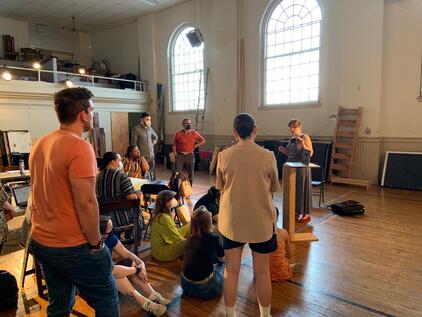
Our first workshop, held in the Theatre Exile Studio X Space (and, in case you were curious, held on the set of their production of The English Bride, in which you still have a few days to catch Damon starring in "a fast-paced explosion of love, lies, and terrorist plots") brought us all in the room together for the first time. Led by Dan, we picked apart some text, got on our feet, laughed a lot, and talked through some of the other apprentice-type stuff. (We think it's really important to make work in all the areas of the company a critical component of this program. The brave six will be tackling production jobs, load-ins, marketing campaigns, opening night planning, house management, and the ever-critical "spreadsheet maneuvering." Additionally, they'll all be blogging for us throughout the season, so check back for more words as they share their own experiences). 

Picture
We're so excited and can't wait for you to see them onstage. In the meantime, if you happen to see any of them toting backpacks filled with PAC brochures or quietly learning monologues on the subway, be sure to say hi. And welcome them to the family.

(From left to right, front row: Merci Lyons-Cox, Ashley Thornton, Victoria Chau, Angie Fennell. Back row: Brendan Dalton, Adam Darrow).